
Top 10 Demister Pad Manufacturers in India 2026
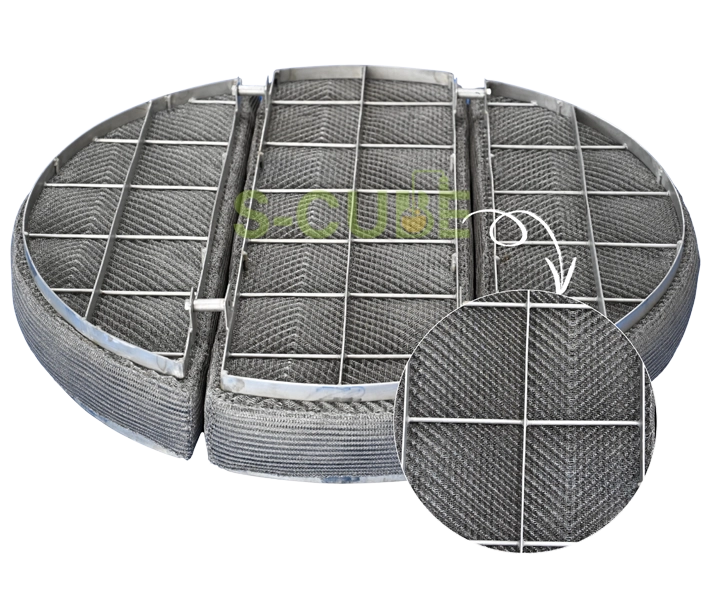
Welcome to S Cube Mass Transfer Pvt. Ltd. is leading Demister Pad Manufacturers in India. We provide application-focused Demister Pad solutions for industrial vessels, columns, separators, scrubbers and other process equipment.
We support new requirements, replacements, revamps and customized configurations by reviewing operating conditions, equipment dimensions and separation requirements. Our approach combines reliable product quality, practical engineering support and cost-conscious, requirement-based pricing. We can supply configurations suited to different gas velocities, separation duties, installation limitations and material requirements.
What Is a Demister Pad and How Does It Work?
A Demister Pad is a mist-elimination device used to separate entrained liquid droplets from gas or vapour streams in process equipment. It is commonly installed in columns, vessels, scrubbers and separators to minimize liquid carryover and support efficient gas-liquid separation. For existing or replacement requirements, selection involves more than equipment diameter. Factors such as operating conditions, gas velocity, gas and liquid properties, allowable pressure drop, required separation performance, pad construction and the existing installation arrangement are considered to determine a suitable configuration.
Different Types of Demister Pad
As Demister Pad Manufacturers, Suppliers and Exporters in India, we offer different demister configurations to suit specific process, equipment and separation requirements.
- Wire Mesh Demister Pad: Knitted wire mesh captures and coalesces fine liquid droplets from gas or vapour streams. Its mesh arrangement is selected according to gas velocity, droplet characteristics and separation requirements.
- High-Efficiency Demister Pad: Designed for applications requiring enhanced removal of entrained liquid from gas or vapour streams. The configuration is selected by considering separation performance, operating velocity and allowable pressure drop.
- High-Capacity Demister Pad: Suitable for applications where higher gas flow rates or greater process capacity need to be accommodated. Its configuration is determined from actual operating conditions, gas velocity and required separation performance.
- Multi-Layer Demister Pad: Made with multiple mesh layers to provide a configuration suited to specific mist-removal requirements. The number and arrangement of layers can be considered according to process conditions and separation duty.
- Sectional Demister Pad: It is manufactured in separate sections for large vessels or equipment with limited manway access. Section dimensions are planned according to vessel size, support arrangements and available installation space.
- Customized Demister Pad: Designed around specific vessel dimensions, mesh requirements, materials and operating conditions. Customized configurations can also consider pad thickness, support details, section sizes and installation requirements.
What Information Is Required for a Replacement Demister Pad?
When replacing an existing Demister Pad, providing accurate equipment and process information helps us review the application and recommend a suitable replacement configuration. Share the following details wherever available:
| Information Required | Details to Provide | Why It Matters |
|---|---|---|
| Existing Equipment Drawing | Vessel, column, separator or scrubber drawing | Helps us understand the equipment dimensions and existing demister arrangement. |
| Demister Diameter | Existing pad diameter or vessel-side dimensions | Helps establish the required replacement size and fit. |
| Demister Thickness | Existing pad thickness | Supports evaluation of the replacement pad configuration and installation space. |
| Mesh Specification | Existing mesh type, density or specification, if available | Helps assess the existing construction and separation arrangement. |
| Material of Construction | Existing wire or pad material | Supports material compatibility with the process environment. |
| Support-Grid Details | Grid arrangement, support type and available dimensions | Helps ensure the replacement pad is suitable for the existing support arrangement. |
| Manway Size | Available vessel access or manway dimensions | Helps determine whether the pad should be supplied in sections for installation. |
| Gas Flow Rate | Normal, minimum and maximum flow where available | Helps evaluate gas velocity and the required mist-removal configuration. |
| Operating Pressure | Normal operating pressure and relevant range | Supports process evaluation and appropriate Demister Pad selection. |
| Operating Temperature | Normal operating temperature and relevant range | Helps assess material suitability and operating conditions. |
| Gas Properties | Gas composition, density and other available properties | Helps evaluate separation requirements and operating performance. |
| Liquid Properties | Liquid composition, density and other relevant properties | Helps assess droplet separation requirements and material compatibility. |
Key Features of a Demister Pad
As Demister Pad Manufacturers in India, we provide demister solutions designed for quality, flexibility and application-specific process requirements.
- Efficient Mist Capture: Knitted mesh construction captures and coalesces entrained liquid droplets from gas or vapour streams.
- Application-Based Design: Configuration can be selected according to gas velocity, process conditions, vessel dimensions and separation requirements.
- Flexible Construction: Available in different mesh arrangements, thicknesses, materials and sectional configurations to suit installation needs.
- Controlled Pressure Drop: The mesh arrangement can be evaluated to achieve the required mist-removal performance within the specified pressure-drop limit.
- Easy Equipment Integration: Designed for installation inside columns, vessels, separators, scrubbers and other suitable process equipment.
- Replacement Compatibility: Existing dimensions, support arrangements and installation details can be considered when supplying replacement pads.
- Material Selection Options: Construction materials can be selected according to temperature, chemical exposure and corrosion requirements.
- Customizable Configuration: Pad size, mesh density, thickness, section dimensions and support details can be tailored to the application.
Benefits of Using a Demister Pad
As Demister Pad Manufacturers in India, we provide solutions that support effective mist removal, reduced liquid carryover and reliable gas-liquid separation.
- Reduced Liquid Carryover: Helps limit the amount of entrained liquid leaving the process equipment with the gas or vapour stream.
- Improved Gas-Liquid Separation: Supports more effective separation of liquid droplets from process gas and vapour.
- Downstream Equipment Protection: Reduced mist carryover can help minimize unwanted liquid exposure and contamination in downstream equipment.
- Reduced Product Loss: Effective droplet capture can help retain valuable process liquids within the intended process system.
- Reliable Process Operation: A correctly selected configuration supports consistent mist-removal performance under the specified operating conditions.
- Installation Flexibility: Sectional and customized arrangements can accommodate large vessels and restricted manway access.
- Suitable for Diverse Industries: Can be configured for applications across chemical, petrochemical, oil and gas, refinery and other process industries.
Applications of Demister Pad
As Demister Pad Manufacturers in India, we offer configurations suitable for diverse process equipment requiring effective gas-liquid separation and mist removal.
- Distillation Columns: Helps remove entrained liquid droplets from vapour streams to support efficient column operation.
- Absorbers: Helps minimize liquid carryover from gas streams leaving absorption equipment.
- Scrubbers: Captures mist droplets from treated gas before the gas exits the scrubbing system.
- Separators: Supports the removal of entrained liquid from gas before it moves to downstream equipment.
- Knockout Drums: Provides additional mist separation where effective gas-liquid separation is required.
- Flash Vessels: Helps separate liquid droplets carried with vapour generated during the flashing process.
- Evaporators: Reduces liquid entrainment in vapour streams leaving evaporation equipment.
- Gas-Treatment Systems: Helps control liquid carryover in gas-processing and conditioning applications.
- Chemical-Processing Equipment: Supports gas-liquid separation across a range of chemical process operations.
- Petrochemical Facilities: Used in process vessels where controlling liquid entrainment is important for reliable operation.
- Oil & Gas Separators: Helps remove entrained liquids from produced or processed gas streams.
- Refinery Equipment: Supports mist elimination in refinery vessels and gas-processing equipment.
- Pharmaceutical Processes: Used where controlled gas-liquid separation is required in suitable process equipment.
- Solvent-Recovery Systems: Helps separate solvent droplets from vapour streams to support recovery and downstream process performance.
What Parameters Are Considered for Demister Pad Selection?
The right Demister Pad is selected by evaluating key process and equipment conditions that influence separation efficiency, capacity and reliable operation.
| Parameter | Selection Consideration |
|---|---|
| Gas Flow Rate | Determines the required gas-handling capacity. |
| Gas Density | Influences gas velocity and droplet separation. |
| Liquid Density | Affects droplet behaviour and separation performance. |
| Operating Pressure | Helps establish process and gas operating conditions. |
| Operating Temperature | Guides material and process suitability. |
| Gas & Liquid Composition | Supports material compatibility and process evaluation. |
| Equipment Diameter | Determines the available pad size and installation area. |
| Allowable Pressure Drop | Helps select a suitable mesh configuration. |
| Separation Efficiency | Defines the required mist-removal performance. |
| Droplet Characteristics | Influences liquid-droplet capture and coalescence. |
| Fouling & Corrosion | Helps determine suitable construction and materials. |
| Turndown Conditions | Ensures performance across the required operating range. |
| Gas Velocity | Affects separation efficiency and the risk of liquid re-entrainment. |
Why Choose Us?
- Application-Focused Solutions: We assess your process conditions, equipment dimensions and separation requirements to provide a Demister Pad configuration suited to the application.
- Quality-Focused Manufacturing: We maintain attention to mesh construction, dimensions, materials and finishing to support dependable performance in demanding process environments.
- Customized & Replacement Support: We handle new, replacement and customized requirements, including sectional Demister Pads for vessels with restricted installation access.
- Practical & Cost-Effective Approach: We combine technical understanding with requirement-based solutions to deliver reliable Demister Pads while keeping project requirements and costs in focus.
Choose S Cube Mass Transfer Pvt. Ltd. is well-known Demister Pad Manufacturers, Suppliers, and Exporters in India. We provide Demister Pad solutions for new installations, replacements and customized process requirements. We consider equipment dimensions, operating conditions and separation needs to develop suitable configurations. With our focus on quality, technical support and practical pricing, we help customers achieve dependable mist removal across diverse industrial applications. Connect with us for additional details.
FAQ’s
The main purpose of a Demister Pad is to remove entrained liquid droplets from gas or vapour streams. It helps reduce liquid carryover and supports efficient gas-liquid separation in process equipment.
No, an industrial Demister Pad is not designed for installation on mirrors or for preventing bathroom mirror fogging. It is a process-equipment component used inside vessels, columns, separators and other gas-liquid separation systems.
Gas or vapour passes through the knitted mesh, where entrained droplets are captured and coalesced. The collected liquid then drains back into the vessel while the cleaner gas continues downstream.
The material is selected according to process temperature, gas and liquid composition and corrosion requirements. The appropriate material of construction should therefore be determined from the actual operating environment.